
Flat vs. Gusseted Poly Bags: Size and Thickness Guide
KEVIDKO · Buying Guide
Flat vs. Gusseted Poly Bags: Size and Thickness Guide
Choose a bag around the product you actually pack. Compare flat and expanding formats, seven listed options, and the case quantities behind your order.
Start with the shape of what you pack.
A bag that looks generous on a size list can be tight once it wraps around a thick product. Choose the construction first, then the dimensions, film thickness, and case quantity.
Flat poly bags
A flat bag has two main faces without an expanding side gusset. Its listed width is the width of the empty bag laid flat—not the width of a rigid box it will hold. The film must also wrap around the product’s thickness.
Start here for relatively flat items and general packaging where a simple open-top format works.
Gusseted poly bags
Folded sides expand to make room for depth. For the explicitly labeled gusseted products below, dimensions are shown as face width × gusset depth × length.
Consider this format for a product with more depth or a rectangular profile. A gusset provides room; it does not guarantee that a filled bag will stand upright.
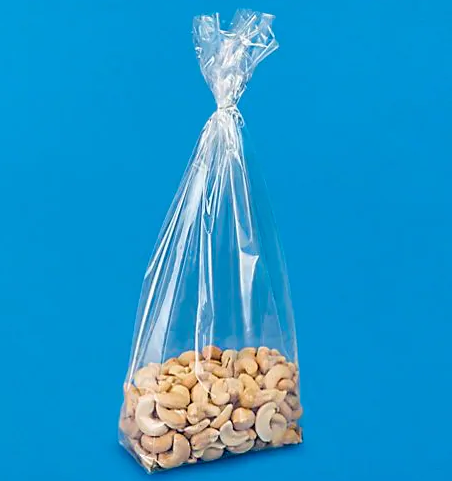
Measure the packed product, not just its front face.
- Set up the actual pack. Include trays, boards, labels, or multiple items that will go inside.
- Record width, depth, and length. Measure the largest points, including irregular edges.
- Leave loading and closure room. A twist tie, fold-over, or heat seal needs material beyond the product. Use the allowance required by your process rather than a universal rule.
- Check how the supplier lists dimensions. Confirm gusset conventions and usable space inside seals if the fit is close.
- Trial the complete workflow. Load, close, handle, and remove the package before committing to production quantities.
Compare selected stocked formats.
These are listing dimensions, not guaranteed usable interior measurements. Follow the product link to confirm the current specification before ordering.
| Product / SKU | Construction | Listed dimensions | Film | Bags/case |
|---|---|---|---|---|
| 8 x 10" Clear Flat Poly Bags, 1 Mil (1,000/Case) SKU 019650 | Flat | 8 × 10 in. | 1 mil | 1,000 |
| 8x12" 1 Mil Clear Poly Bags (1,000/Case) SKU 01965 | Flat | 8 × 12 in. | 1 mil | 1,000 |
| 10 x 17" Clear Flat Poly Bags, 2 Mil (1,000/Case) SKU 01970 | Flat | 10 × 17 in. | 2 mil | 1,000 |
| 16 x 32" Clear Flat Poly Bags, 1 Mil (1,000/Case) SKU 01976 | Flat | 16 × 32 in. | 1 mil | 1,000 |
| 20x30" 2 Mil Clear Poly Bags (250/Case) SKU 01985230 | Flat | 20 × 30 in. | 2 mil | 250 |
| 4 x 2 x 12" Clear Gusseted Poly Bags, 1 Mil (2,000/Case) SKU 01952510 | Gusseted | 4 × 2 × 12 in. | 1 mil | 2,000 |
| 5 x 3.5 x 15" Clear Gusseted Poly Bags, 1 Mil (1,000/Case) SKU 01953640 | Gusseted | 5 × 3.5 × 15 in. | 1 mil | 1,000 |
Choose thickness after you have a workable fit.
A mil is one-thousandth of an inch. A 2 mil film is twice the nominal thickness of a 1 mil film, but that does not mean a finished bag has twice the strength. Film formulation, seams, product edges, loading, and handling also affect performance.
Trial lighter film for an easy-to-load product with smooth edges. Consider a heavier listed film when your existing bag is being damaged in handling—but check the fit and the source of the damage before simply increasing thickness.
Do not assume that a general-purpose poly bag is a vacuum pouch, cooking bag, or approved package for a particular food process. For direct food contact or temperature-sensitive use, request the specification for the exact item. See our vacuum pouch guide for machine-related selection.
Buy the case you can actually use.
A lower case price does not always mean a lower cost per bag. Check the count beside the price: the options above range from 250 to 2,000 bags per case.
Before you buy more, prove the fit.
Load your actual product, close the bag, and handle it the way your team will. A bag that is awkward to load or too short to close can cost more in wasted time than you save on the case.
Once the size works, look at how many you use in a normal week and how much room you have to store them. Save the item number and a photo of the label so the next order is easy.
Need help choosing a bag?
Send your packed product’s dimensions, current bag label, closing method, and expected usage. A clear photo alongside a ruler helps us narrow the options without guessing.
Ask KEVIDKOExplore more purchasing resourcesBy KEVIDKO · Reviewed September 27, 2026. Product pages show current pricing, specifications, and availability.